Invoice tracking and collections for construction contractors
Paymely is collections software built in Quebec that follows up on your job invoices for you. While you're on site, your client gets reminders by email, with the invoice attached, or by SMS. If the account drags on, you call from the client profile, in your browser, with Paymely's virtual phone.
- General contractor
- Trade contractor
- Residential renovation
Every message carries your company's name. Paymely is software and never acts as a collection agency.

Work done, invoice open
Why does a late payment weigh so heavily in construction?

In a five-person company, nobody has receivables as their job. Follow-up happens in the evening, after the job site, or it doesn't happen.
What your client sees
The last instalment on a roof, followed to the deposit
Example: a roof redone for $13,500.00, with the last instalment of $3,375.00 still to come. The invoice number, amount and due date come from your client list; every sentence is one you wrote in your templates.
Hi Martin, your roof is finished. Here is invoice #1047: last instalment of $3,375.00, due Friday. The PDF is attached.
[Your company]: the $3,375.00 instalment (invoice #1047) is due today. A question about the work? Reply to this text.
Martin, $3,375.00 is still owing on your roof. Interac e-Transfer to accounts@… or a cheque at the office. Thank you!
Interac e-Transfer received · $3,375.00 · approved by your office
In Paymely
What does Paymely do between the invoice and the deposit?
The invoice goes out with the reminder
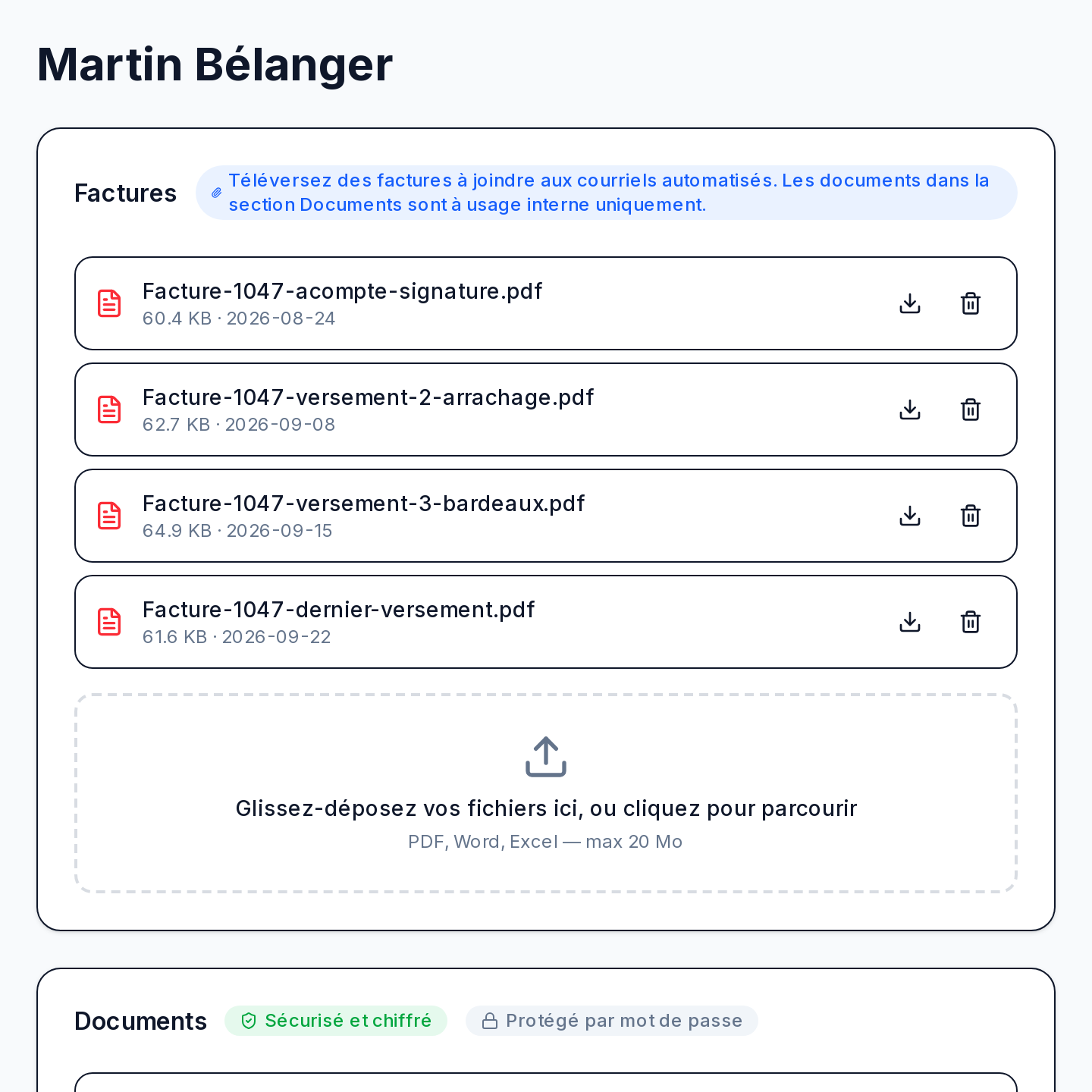
Upload the PDF to the client profile. It attaches to reminder emails once the option is checked in your schedule.
Polite first, firm later
You decide once on the message, the delay and the channel for each step. The sequence then moves along without you.
Interac recognized, cheque recorded
Paymely matches the Interac e-Transfer to the right client, then waits for your office to confirm. A cheque or cash is recorded by hand.
A balance paid in instalments
The client offers three payments? Assign them to a recurring schedule: each instalment gets its own reminder.
Their texts, on their profile
“I'll drop by the office Thursday”: the client's reply lands in Paymely, not on an employee's cell phone.
Virtual phone
For the account that answers nothing, you place the call from the client profile. The length of the call is added to the history.
The job site, named in the message
Site address, project number, project manager's name: your own fields drop into your templates as tags.
Before you chase by hand
Why trust your follow-ups to Paymely instead of your memory?
- 01
Nothing is marked paid without you
Paymely recognizes the payment and shows it for approval. The invoice is marked paid only once someone in your office confirms it.
- 02
A dated record of every follow-up
Emails, texts, calls: everything is logged on the client's file, and the history can be exported. If the file ends in a demand letter, the timeline is already built.
- 03
The signed contract, kept safe
Accepted quote, contract, change orders: once uploaded to the client's Documents, they are encrypted and need your Paymely password to open. They stay internal.
Recent laws and figures
Is prompt payment becoming the rule in construction?
Both regimes cover public contracts. On a private contract, follow-up stays in your hands. Paymely publishes no customer results; sources are at the bottom of the page.
Questions from contractors
What should you do when a client doesn't pay a construction invoice?
Follow up in writing, early, and keep a record of every message: some remedies, such as the legal hypothec, have short deadlines [1]. Paymely sends the reminders and keeps the history. The demand letter and the remedies themselves are for your lawyer or notary.
Does Paymely replace my invoicing software?
No. You invoice the way you do today. Paymely takes over once the invoice is issued: your clients are imported from a CSV or Excel file, or from a Google Sheets spreadsheet, then reminders go out by your rules.
My clients mostly pay by cheque. Is that a problem?
No. You record the payment by hand and pick the method: cheque, cash, credit card or transfer. Once the balance is paid, the client leaves the sequence and gets no more reminders.
The client is holding back payment over a deficiency. What happens?
Remove them from the sequence: no more reminders go out. Messages already sent and their text replies stay on their profile while the dispute is sorted out.
Can a contractor follow up with clients by text in Quebec?
Yes. Collecting your own invoice requires no collection agent permit. The practices prohibited by the Act respecting the collection of certain debts, such as harassment or threats, still apply to everyone [9]. In Paymely, you set the send times and the client opts out of texts by replying STOP or ARRÊT.
How long does it take to get started?
One meeting is enough to begin. We import your clients with you and build your first sequence. No software to install: Paymely opens in a browser.
Sources
Updated November 18, 2026
- Civil Code of Québec, art. 2726 to 2728 (construction legal hypothec), updated to October 15, 2026.
- BC Construction Association, “2026 BC Construction Industry Survey,” April 13, 2026, 858 respondents in British Columbia.
- Commission de la construction du Québec, construction industry page, 2025 figures.
- Office of the Superintendent of Bankruptcy, “Insolvency Statistics in Canada—2025,” updated October 1, 2026.
- Federal Prompt Payment for Construction Work Act, s. 9, current to October 29, 2026.
- Secrétariat du Conseil du trésor du Québec, news release on prompt payment and dispute resolution (in French), September 10, 2025.
- Payments Canada, “Canadian Payment Methods and Trends Report 2025.”
- Interac, “2025 Corporate Year in Review.”
- Act respecting the collection of certain debts (CQLR c. R-2.2), s. 2 to 4, updated to October 15, 2026.
Show us a finished job that isn't paid yet.
During the demo, we build in front of you the reminders that client would have received, in your name and in your words.